|
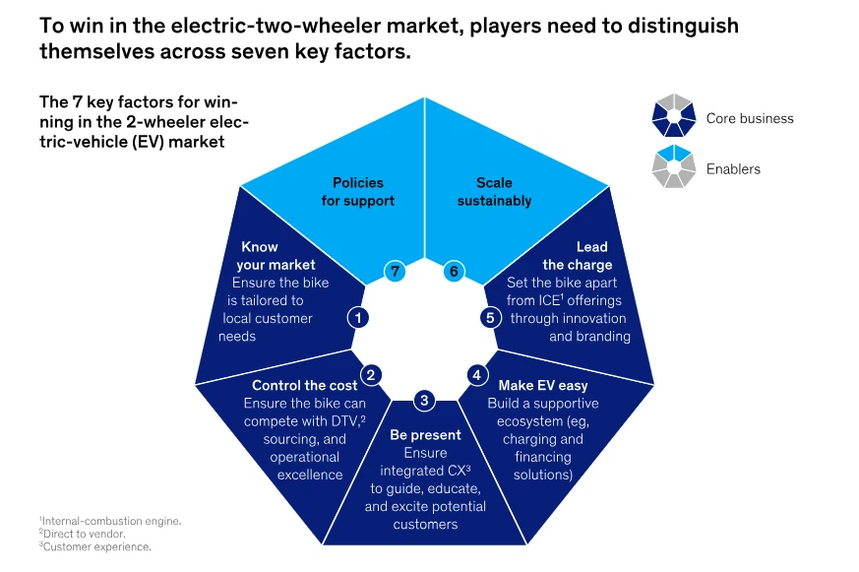
The Real Global EV Buzz Comes On Two WheelsThe global two-wheeler market is massiveThe two-wheeler market is projected to have a compound annual growth rate of 8.7 percent through 2029 when it will reach a value of about $218 billion. Although relatively few two-wheelers are now electric, this could soon change (Exhibit 1). In India, for instance, only about 4 percent of two-wheeler sales in 2021 were electric. Worldwide, however, we project that 30 percent of two-wheelers will be electric by 2030. While China and the developing world concentrate on smaller, typically work- or transportation-focused machines, North America (excluding Mexico) and Europe are more bifurcated, with premium brands selling more than 500 cubic capacity products. These luxury and high-performance machines stretch into the heavyweight and superheavyweight segments, which consumers typically buy for recreational and sporting purposes. Many of the established brands in these segments have been slow to introduce electric versions of their machines, although some are finally developing their first electric models. Newcomers sensing a market entry opportunity in these potentially lucrative segments have led the way so far. However, cost premiums and range issues linked to battery chemistry and a lack of purchasing scale pose real barriers to converting die-hard high-performance and long-distance riders. The low electrification rate of two-wheelers has major implications for climate change. In regions where two-wheelers are the main mode of transportation, they consume more than 50 percent of the total gasoline. Moreover, these vehicles account for 5 to 10 percent of CO2 emissions. As more countries attempt to achieve net-zero-emission targets and reduce pollution in cities, the move to electrify two-wheelers could become more urgent. Based on experience with the four-wheeled market, government regulations supporting electric two-wheelers could ignite major change and potentially stimulate sales. China, for instance, leads the world in electric-vehicle (EV) adoption rates because its government has strongly supported the push for electrification. Greater consumer interest in electric two-wheelersTraditionally, the rate of electrification has been under 5 percent across all major two-wheeler markets because of several obstacles. These include higher acquisition costs, lower performance in comparison with internal-combustion-engine (ICE) variants, limited product options from incumbents, and the lack of finance and charging ecosystems. However, the segment is poised for disruption, as most of these issues are being addressed. With significant improvements in battery technology, electric two-wheelers are no longer limited by range. The current energy density of lithium iron phosphate (LFP) and nickel manganese cobalt (NMC) batteries is already between 180 and 250 Wh/kg, respectively, which is capable of giving 80 to 120 kms per charge. Additionally, the TCO of electric two-wheelers is already on par with ICE vehicles in many regions, which are soon set to become cheaper than ICEs. Battery costs, which have traditionally comprised about 35 percent of the two-wheeler’s bill of materials (BOM) value, are falling significantly as manufacturers attain economies of scale and production efficiencies, along with the general shift toward lower-cost LFP batteries. Electric two-wheelers benefit from regulatory initiatives like consumer subsidies of up to 25 percent of their costs, surging oil prices, and the fact that traditional fossil fuel subsidies are increasingly being rolled back in various countries. The TCO of locally assembled electric two-wheelers in countries like Indonesia has now reached breakeven and should become even cheaper as the EV industry continues to mature. Customer expectations for engagement have evolved significantly since the COVID-19 pandemic. Automotive companies once competed on the prowess of engineering. The new battleground involves tech-enabled, data-rich consumer experience, where EV companies currently have the upper hand. While young consumers value robust engineering, they also consider EVs an extension of their lifestyles. One EV company’s CEO stated his customers aren’t just buying a vehicle, they are buying a ticket to a new lifestyle. Competing on this new battleground requires a new business model that focuses on recurring sales of services and products. To start with, two-wheeler OEMs will have to adopt a hybrid sales channel that offers the convenience of online product selection and information, along with customization options and the opportunity to take offline test-drives to build trust. This experience should extend beyond sales and stay with the customer throughout the ownership journey in the form of on-call or over-the-air (OTA) vehicle health diagnostics and OTA performance updates, among other features. Considering these tailwinds, more players have entered the market, increasing the accessibility to these vehicles for consumers. While traditional incumbents have benefited from this market shift, local OEM attackers have experienced significant success based on their agility and ability to understand their consumers. In China and India, in particular, new entrants have performed exceptionally well by focusing on cost leadership strategies. Success factors for the electric-two-wheeler marketEntering the electric-two-wheeler space requires a switch for owners who are often motivated more by ease of use, convenience, and price than excitement. To win in this rapidly changing arena, we have identified the following dimensions that electric-two-wheeler players must get right to win (Exhibit 2). |